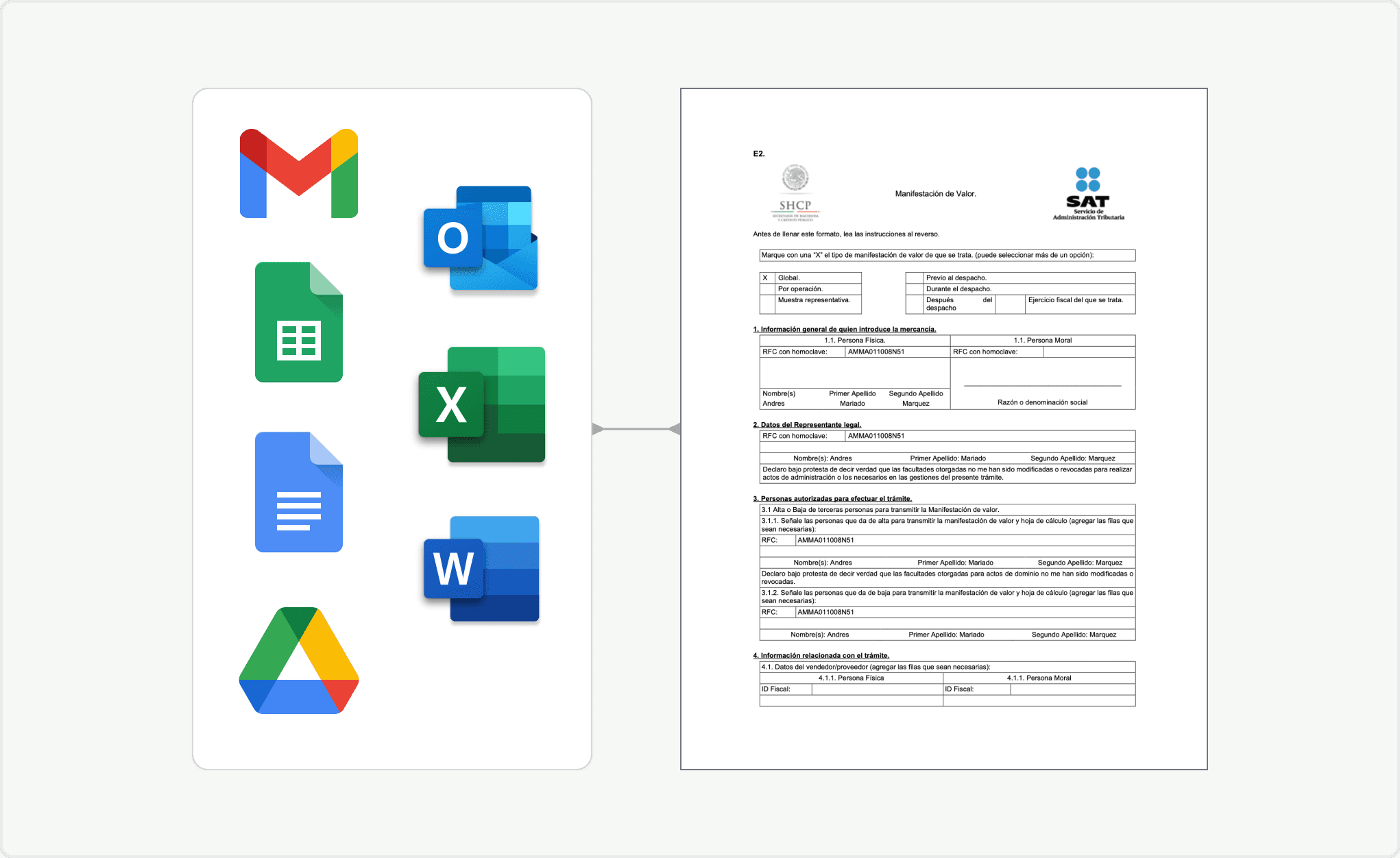
INVOICEPDF / SOURCE 01
Line item01✓
UnitPiece✓
Quantity1,200✓
EVIDENCE 01
contract
DESTEIA VERIFICA
CAPABILITIES
Document review at scale, without losing context.
READING WITHOUT RIGID TEMPLATES
Recognizes documents even when the supplier changes the filename, field layout or format.
LINE-ITEM EXTRACTION
Extracts quantities, values, descriptions, part numbers and other relevant fields from each line.
LINKED TO THE CUSTOMS DECLARATION
Links every document and line item to the corresponding import declaration.
CROSS-DOCUMENT COMPARISON
Cross-checks invoices, packing lists, purchase orders, bills of lading, Carta Porte, COVE and customs declarations.
INCOTERMS VALIDATION
Compares the declared Incoterm against commercial documents and the criteria configured for the operation.
CONFIGURABLE RULES AND TOLERANCES
Define what must match, which variation is acceptable and when a discrepancy must be escalated.
REVIEW ACROSS THE FULL OPERATION SET
Can cover the operations and sources authorized for the project, rather than only a manual sample.
EXCEPTION PRIORITIZATION
Ranks findings by amount, error type, date, supplier, plant or risk level.
CORRECTION WORKFLOW
Assigns owners, preserves comments, records evidence and tracks the status of each case.
DECISION HISTORY
Documents who reviewed, corrected, accepted or closed each exception.
OUTCOMES
Fewer documents to open. More exceptions resolved.
DISCREPANCIES FLAGGED IN TIME
Your team detects inconsistencies before they reach the next stage.
BROADER REVIEW
Automation lets you review the agreed set of operations instead of relying exclusively on samples.
LESS REWORK
Each case shows the data, documents and people involved.
CONSISTENT CRITERIA
The same rules and tolerances can be applied across plants, teams and customs brokers.
ERROR PATTERNS
Desteia identifies suppliers, fields and processes that generate recurring discrepancies.
AUDIT EVIDENCE
Findings, documents, decisions and corrections remain linked to the operation.
BEFORE AND AFTER CLEARANCE
One visible discrepancy, with the evidence already compared.
BEFORE CLEARANCE
Detect inconsistencies while they can still be corrected without disrupting a cleared operation.Review:- Missing documents.- Quantities and values.- Part numbers.- Commercial descriptions.- Countries of origin.- Tariff classifications.- Units of measure.- Incoterms.- Dutiable additions and deductions.- Customs declaration information.Result: an operation reviewed before payment, release or submission.
AFTER CLEARANCE
Review completed operations to find discrepancies, prepare amendments and detect recurring patterns.Identify:- Repeated supplier errors.- Discrepancies associated with a customs broker.- Different criteria across plants.- Fields with frequent errors.- Operations needing additional review.- Cases that may require amendment.Result: a control program that learns from exceptions and reduces recurrence.
VALUES COMPARED
Invoice: 1,200 piecesPacking list: 1,200 piecesCustoms declaration: 1,250 pieces
FINDING
A difference of 50 pieces in the import declaration.
EVIDENCE
Invoice and packing list linked to the line item.
SUGGESTED NEXT STEP
Confirm the quantity with the owner and request a customs broker review before releasing the operation. The specialist retains the final decision.
FREQUENTLY ASKED QUESTIONS
What you need to know.
WHAT IS A FOREIGN TRADE DOCUMENT AUDIT?
It is a review of the documents and data supporting an operation to identify missing information, discrepancies or inconsistencies before or after clearance.
+
WHICH DOCUMENTS CAN DESTEIA REVIEW?
Invoices, packing lists, purchase orders, bills of lading, air waybills, certificates, COVE, CFDI with the Carta Porte complement and import declarations, among others.
+
CAN IT REVIEW CARTA PORTE?
Yes. When included in the scope, Desteia can extract information from CFDI with the Carta Porte complement and compare it against other documents for the operation.
+
CAN IT VALIDATE INCOTERMS?
Desteia can extract the declared Incoterm and compare it against invoices, purchase orders and configured criteria. Contractual interpretation remains the specialists’ responsibility.
+
DOES IT REVIEW BEFORE OR AFTER CLEARANCE?
It can be used at both stages: before clearance to prevent discrepancies and afterward to detect errors, prepare corrections and identify patterns.
+
DOES DESTEIA AUTOMATICALLY CORRECT THE CUSTOMS DECLARATION?
No. It detects the inconsistency, presents the evidence and lets you request or document a correction. The specialist and customs broker retain the corresponding decisions and execution.
+
DOES DESTEIA REPLACE THE CUSTOMS BROKER?
No. It facilitates review and evidence sharing with the customs broker but does not replace their functions or responsibilities.
+
CAN IT REVIEW 100% OF OPERATIONS?
It can process all operations included in the scope, provided the necessary sources and data are available.
+
HOW DOES IT AVOID IRRELEVANT ALERTS?
Rules and tolerances are configured by operation type. Your team can document accepted exceptions and adjust criteria without losing the history.
+
WHAT HAPPENS WHEN IT DETECTS A DISCREPANCY?
It creates a case with the compared data, evidence, impact and owner. Your team decides whether to request a correction, escalate the case or accept the exception.
+
YOUR NEXT OPERATION
Find the discrepancy before an audit does.
We review a sample of documents and customs declarations with you to show how Desteia identifies inconsistencies and presents every exception with its evidence.
REQUEST AUDIT ↗